
Company Strike Off
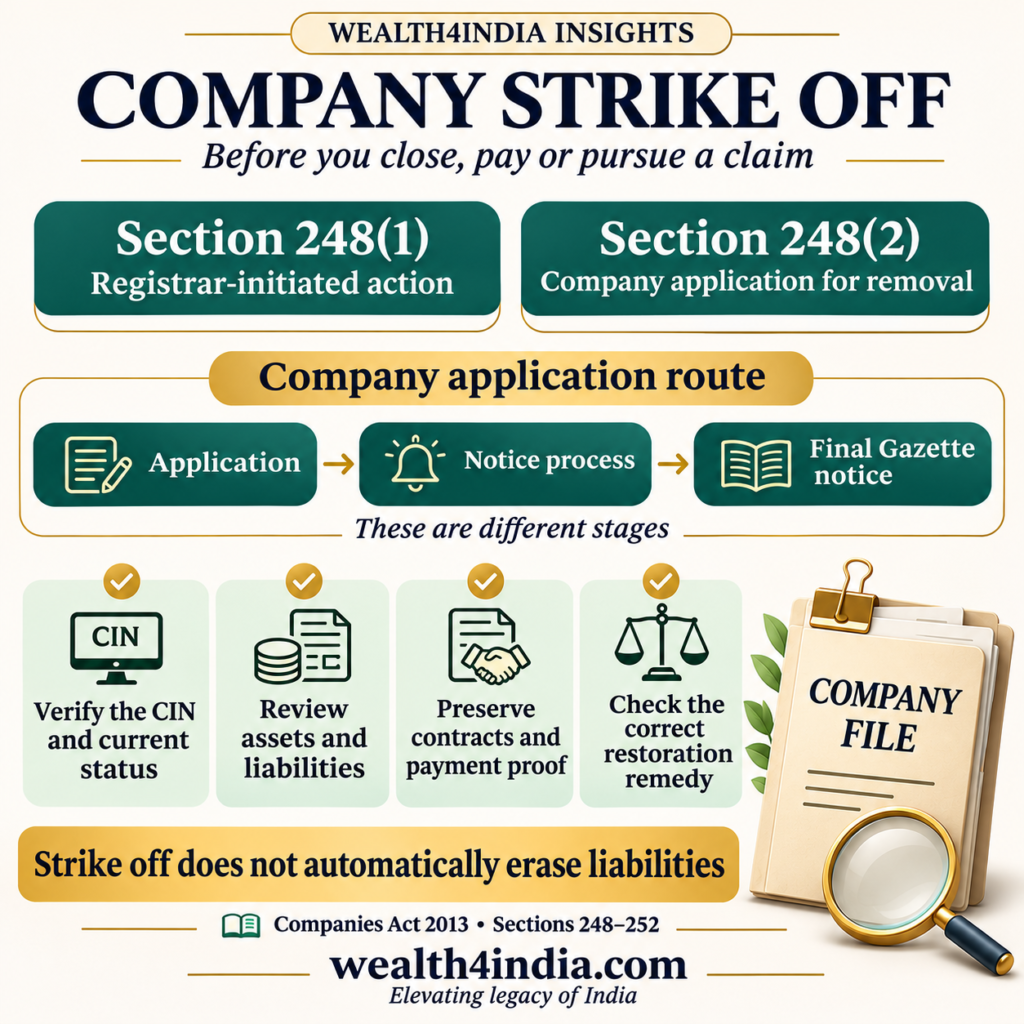
7 Essential Checks Before Closing a Company or Paying a Business Counterparty
By Wealth4India Insights | Updated 11 November 2026
You are about to pay a supplier, recover an old invoice or close an inactive business. Then someone shares an MCA company strike off update. Does it mean the company is fraudulent, its debts have disappeared or its directors can immediately start again under the same name?
None of those conclusions follows automatically. A company strike off affects corporate status, but the route, effective date, outstanding obligations and possible restoration all need separate checks.
The October 2026 screenshot circulating online refers specifically to section 248(2) of the Companies Act 2013. Its wording is corroborated by an indexed copy of the Ministry’s social post, but the underlying October download was not directly accessible in this review. No October company total or individual entry is represented here as verified.
The useful response is to check the entity and the relevant legal record. This seven-point guide helps directors, creditors and business owners decide what to examine next.
1 Match the company to its CIN
Start at the official MCA portal. Identify the entity by its Corporate Identity Number and exact registered name. Match these details to the contract, invoice and proposed payee. A trading brand may be different from the incorporated entity behind it.
Retrieve current company information and review the relevant public records, notices and orders. Save a dated copy. A monthly list is a historical record for a period; it may not show a later restoration or other change relevant to today’s transaction.
Before paying: Can you explain why the entity on the agreement, invoice and bank beneficiary record is the correct contracting party? If there is a discrepancy, obtain the supporting explanation before proceeding.
2 Understand who initiated the removal
Under section 248 of the Companies Act 2013, the Registrar’s action under subsection (1) differs from a company’s application under subsection (2).
The company-application route requires, among other things, extinguishing liabilities and a special resolution or consent of 75 per cent of members in terms of paid-up share capital, on applicable statutory grounds. Special regulatory approvals may also be relevant. Subsection (3) excludes section 8 companies from this route.
An application, an intermediate notice and final dissolution are different stages. Do not label every application a completed closure. A ROC compliance review can establish which records and requirements apply to your company.
3 Test whether voluntary closure is actually suitable
Stopping sales does not prove that a company is ready for removal. It may still own an asset, owe a customer advance, have an employee claim or face a tax matter.
Section 249 restricts applications in specified situations. The review includes relevant activity in the previous three months, including certain name or registered-office changes, asset disposals and other activity, and specified arrangements or winding-up situations. These restrictions require a fact-specific assessment, not a generic statement that the company has been inactive.
Before deciding the route, ask for a written eligibility and compliance review. Identify remaining filings and procedural requirements instead of assuming strike off is a substitute for addressing the company’s records.
4 Resolve the financial story before making declarations
Prepare a closing reconciliation that someone else can follow from the books to the bank and supporting documents.
| Review area | Evidence and action |
|---|---|
| Bank accounts and cash | Reconcile balances and unexplained transactions |
| Receivables and assets | Establish ownership and document recovery or lawful disposal |
| Creditors and loans | Confirm settlement, releases and any continuing obligations |
| Customer advances | Identify delivery, refund or settlement commitments |
| Tax and employee matters | Review filings, demands, dues and supporting records |
| Disputes and guarantees | Obtain advice on exposure before signing declarations |
For example, a company with no sales for several years may still have ₹80,000 in its bank, a ₹1.20 lakh customer advance and an unresolved claim. Those facts need resolution and advice; a simple nil turnover explanation does not settle them.
Accounting and virtual CFO support can help reconstruct the financial position. A separate ROC filing and company compliance review should address the corporate records and proposed route.
Corporate closure also should not be assumed to cancel GST or another registration. Review those requirements separately through GST compliance support where applicable.
5 Read the effect of dissolution correctly
Section 248(5) provides for publication of the final notice in the Official Gazette, upon which the company stands dissolved. Under section 250, it then ceases operating as a company, subject to limited purposes relating to realising amounts due and discharging liabilities or obligations.
Section 248(7) preserves the specified persons’ existing liability, if any. This does not automatically turn every company debt into every director’s personal debt. Section 251 separately addresses fraudulent applications intended to evade liabilities or deceive creditors. The facts and legal basis of each claim matter.
6 Choose the next step according to your role
| Your position | Useful next action |
|---|---|
| Director seeking closure | Review eligibility, liabilities, records and the filing route |
| Creditor with an unpaid invoice | Preserve proof of the debt and obtain recovery and restoration advice |
| Customer considering an advance | Verify the current entity, its status and authority to contract |
| Investor or buyer | Review corporate status alongside ownership, accounts and transaction authority |
| Owner restarting operations | Obtain advice on lawful options before using the old company identity |
For a creditor, collect the purchase order, agreement, invoice, delivery evidence, ledger confirmation and correspondence. Record the notice and order dates. Do not discard the file merely because the corporate status changed.
For a proposed payment, a current status check is one part of due diligence, not proof of solvency or a guarantee of performance. Even an active company needs a transaction-specific review.
7 Check restoration rights and limitation promptly
Section 252 provides different remedies with different conditions. Subsection (1) permits an aggrieved person’s appeal within three years of the Registrar’s order. Subsection (3) provides a route for specified applicants, including the company, a member, creditor or workman, before expiry of twenty years from publication of the relevant Gazette notice, subject to its statutory grounds.
The twenty-year provision is not a general extension for every appeal. Identify the applicant, relevant dates, reason for restoration and available evidence. The Tribunal must be satisfied; restoration is not automatic on payment of a fee or completion of a form.
Act on the file: Keep the CIN, notices, Gazette publication, financial records and the reason restoration is needed in one folder. Obtain professional advice early enough to assess the appropriate remedy.
What an initial review should answer
- What is the company’s current status and the relevant effective date?
- Is this an application, a notice stage or a completed dissolution?
- What assets, liabilities and filings remain unresolved?
- Does the proposed action require closure, continued compliance or restoration advice?
- Who will complete the next step, with what evidence and by what applicable deadline?
Request a company status and ROC compliance review with the CIN and purpose of the enquiry. If you are planning a genuinely new business, evaluate company and LLP formation separately; a new registration does not itself settle an old entity’s obligations.
Frequently asked questions
How can I check company strike off status
Search the exact company by CIN on the official MCA portal and review the relevant notices, Gazette publication and subsequent orders. Use a dated record for the decision being made.
Is company strike off proof of fraud
No. Section 248(2) is a company-application route. Allegations of fraud require their own evidence and legal basis; the status label alone is insufficient.
Can an inactive company simply stop filing returns
Inactivity does not itself complete lawful closure. Review the continuing obligations, eligibility and appropriate route before assuming no further corporate compliance is needed.
Does strike off cancel a customer’s refund claim
It should not be treated as an automatic cancellation of the claim. Preserve evidence and obtain advice on liability, recovery and any appropriate restoration proceedings.
Are directors personally liable for every debt after dissolution
Not automatically. Section 248(7) preserves existing liability, if any, of the specified persons. Personal exposure depends on the applicable law and facts.
Is every restoration application allowed for twenty years
No. Section 252(1) and section 252(3) address different routes, applicants and conditions. Obtain advice on the route and relevant limitation dates.
Does the October 2026 image introduce a new rule
Its wording describes a monthly data update. No new amendment, concession or filing deadline is established by that screenshot. The October source file could not be directly verified in this review.
Official legal references
- Companies Act 2013 on India Code: sections 248 to 252, including the conditions, restrictions, effect of dissolution and restoration routes.
- Ministry of Corporate Affairs: official company records and monthly company information. Verify the exact reporting month and current company status before acting.
Checked on 11 November 2026. This guide explains general principles; it does not determine any particular company’s status or eligibility for closure or restoration.
This article is for general information only and does not constitute legal, tax, investment or financial advice. Positions may change with amendments, notifications or judicial rulings. Please consult our team before acting on anything set out here.

wealth4india
Wealth4India Pvt Ltd — an integrated tax, wealth and business advisory practice based in Dwarka, New Delhi, serving clients across India and 35+ countries.
Leave a Reply