
US Midterms 2026: What India Should Watch on Trade, Visas and Wealth
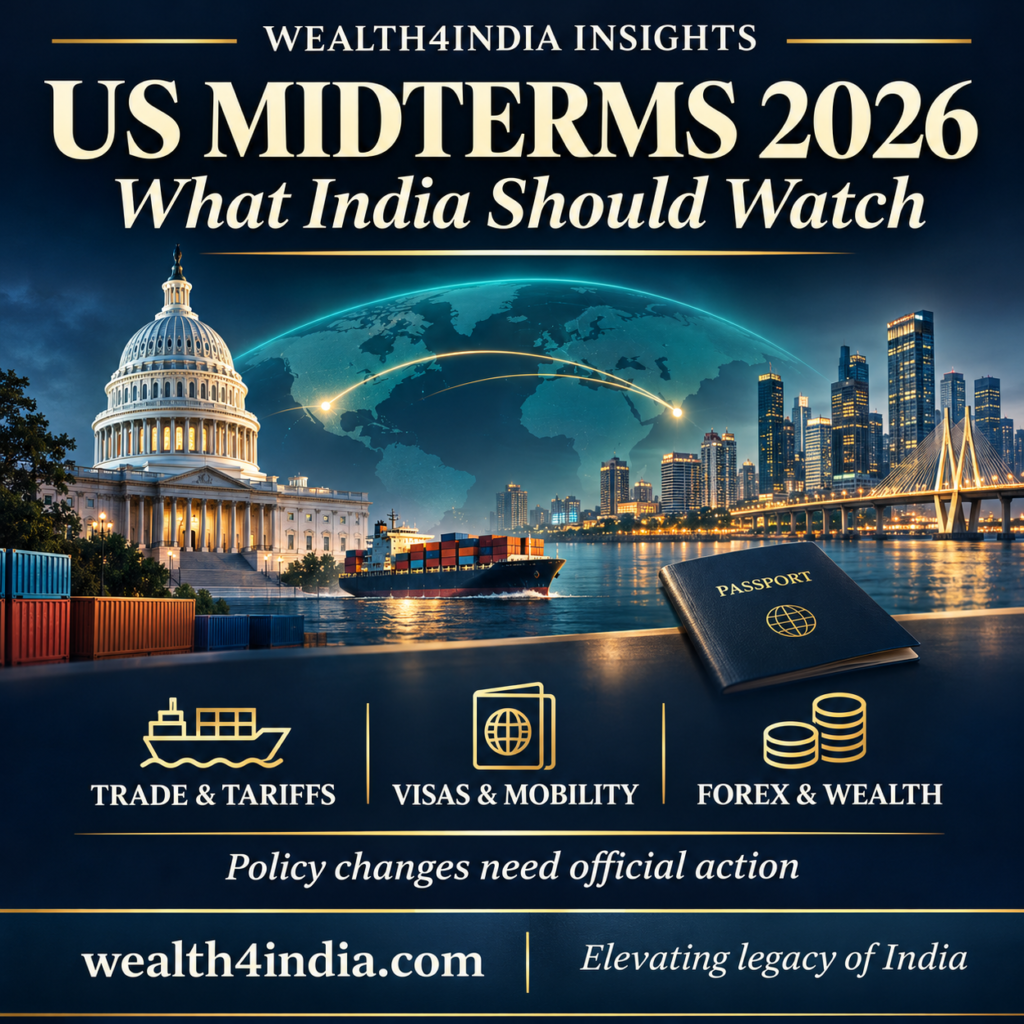
By Wealth4India Insights | Updated 5 November 2026
US midterms 2026 have renewed an important question for Indian businesses and families: will the changed political balance make trade, work visas and investing easier? The immediate task is to distinguish the election outcome from the rules that actually apply to a shipment, an employee or an investment.
Official congressional statements issued on 4 November describe Democrats winning control of both the House and Senate. Senator Peter Welch’s statement refers to gains in both chambers, while Hakeem Jeffries’s letter discusses the incoming House majority. Final election certification is a separate state process, as the US Election Assistance Commission explains.
For India, the significance is substantial: USTR estimates goods-and-services trade with India at US$239.6 billion in 2025. This is a calendar-year US estimate, not an Indian financial-year figure. Export pricing, professional mobility and dollar-linked cash flows therefore deserve a closer review.
What changes in Washington and when
The election chooses the next Congress; it does not elect a new President. Under the Twentieth Amendment, section 1, the new congressional terms begin on 3 January 2027. That timing matters when interpreting promises about what a future majority may do.
Congress has constitutional powers over duties and foreign commerce, while trade statutes delegate specified powers to the executive. Article I, section 7 also sets out the legislative and presidential approval or veto process. A different congressional majority can influence policy, but changes still require the relevant legal steps. Read the US Constitution, Article I and Amendment XX.
Could the outcome be positive for India
Wealth4India analysis: a changed congressional balance could alter oversight, negotiations and the debate on tariffs or skilled migration. It could create opportunities for some Indian interests, while disagreement between Congress and the administration could delay decisions. Neither direction is an assured outcome.
A practical test is to ask what measurable change follows: a notified product concession, an implemented agreement, revised visa instructions or improved order visibility. Those developments would provide a stronger basis for a business decision than a broad label such as positive for India.
US midterms 2026 and India US trade risks
Two government developments provide useful context. India and the US announced an interim trade-agreement framework in February 2026. A Commerce Ministry update issued through PIB on 28 September continued to describe efforts to advance the bilateral agreement and finalise an interim deal. An announced framework should therefore be distinguished from each implemented concession.
Separately, the Commerce Ministry’s 25 July 2026 release on Section 301 measures described an additional 10% duty for covered Indian goods, alongside product exclusions and separate Section 232 treatment. That release should not be read as saying every Indian product has one uniform, all-inclusive 10% tariff.
Before quoting a fresh export order, check the product’s classification, origin, entry date, applicable additional duties and exclusions. Use the current US Harmonized Tariff Schedule and applicable implementation notices with the US importer or customs adviser. A political result alone does not establish a new duty for a particular consignment.
A simple exporter example
Suppose an Indian manufacturer agrees a fixed dollar price before a US shipment. Its margin depends on which party bears import duties, the relevant product treatment, freight and the exchange rate when receipts arrive. An election headline does not settle any of these contract terms. Review the landed-cost calculation before offering a discount based on expected relief.
Businesses reviewing export receivables, cash flow and profitability can use accounting and virtual CFO services to bring the commercial and financial records into one review.
What Indian professionals should know about H 1B rules
Visa policy needs its own check. The White House proclamation dated 18 September 2026 extends the stated restriction on entry of certain H-1B nonimmigrant workers to 21 September 2027. Its operative provisions address a US$100,000 payment for covered petitions and specified exceptions, including a discretionary national-interest exception.
The scope is specific. It should not be presented as a general charge payable by every Indian traveller, student or existing visa holder. Employers must examine the worker’s location, petition and admission circumstances, exceptions and current implementation instructions before deciding whether the requirement applies.
A separate executive order of 18 September 2026 also directs consideration of employer layoffs in specified H-1B-related decisions. These existing policy instruments show why a change in Congress cannot, by itself, be treated as immediate visa-cost relief.
For a planned assignment, check the category and employer requirements, petition stage, consular process and likely start date. The State Department’s temporary-worker guidance is the official starting point for the visa process. Confirm the current requirements for the individual case before committing to travel or a project schedule.
A simple services business example
An Indian technology company may need an employee in the US for a customer project. Before committing to a start date or fixed project fee, it should review lawful staffing options, the applicable immigration process and the effect of delays on delivery and margins. A favourable political expectation cannot substitute for that operational assessment.
What the result means for the rupee and dollar cash flows
Wealth4India analysis: the election may influence market sentiment, but it does not provide a dependable one-way forecast for the rupee, US interest rates or Indian equities. Businesses should work from actual currency exposures and payment dates, then assess the hedging choices permitted under current RBI directions and bank terms.
For example, an exporter receiving dollars and paying most costs in rupees should test how different exchange rates affect margins. An importer with a dollar payment needs a different exposure calculation. Consider our forex and outward remittance services when coordinating the banking and documentation side of a transaction.
What Indian investors and NRI families should review
Use the news as a reason to review exposure rather than as a standalone buy or sell instruction. Look at how much of a portfolio depends on US demand, a single export sector or one currency. Check the time horizon and whether money needed for education, living expenses or a planned remittance is sufficiently liquid.
For families whose employment or travel plans may change, map income, assets, liabilities and upcoming expenses across both countries. The election itself does not complete a residence or tax review. A relocation, altered work pattern or changed source of income may make that review necessary.
For coordinated help, explore family office and wealth planning and NRI tax and FEMA services. Keep decisions tied to the family’s facts and the rules applicable to each transaction.
A practical checklist for the next decision
| Reader | Check before acting |
|---|---|
| Exporter or importer | Product classification, current duties, contractual responsibility, delivery dates and currency exposure. |
| Employer or professional | Visa category, petition scope, current official instructions, possible exceptions and project timing. |
| Investor | US-linked concentration, investment horizon, valuation and liquidity needs. |
| NRI family | Employment plans, residence facts, cash-flow needs and the documentation for planned transfers. |
For each decision, write down the actual trigger: a new notification, a confirmed order, an approved petition or a documented change in personal circumstances. This makes a review easier to update as policy develops.
Frequently asked questions
Do the US midterms immediately change tariffs on Indian goods
The election result itself is not a tariff notification. Check the current product-specific schedule and applicable orders before pricing or shipping.
Does a Democratic congressional majority automatically relax H 1B requirements
No. Existing laws, proclamations and agency instructions require separate legal or administrative action to change. Review the actual rule applicable to the petition.
Is the Section 301 duty mentioned in the July release the total duty on every product
No. The release describes an additional measure with exclusions and separate treatment for some products. The final position depends on the relevant classification and other applicable provisions.
When do the new congressional terms begin
The constitutional term date is 3 January 2027. Election announcements in November should not be confused with the start of the incoming terms.
Should investors change their portfolio solely because of the result
A useful response is to review concentration and cash needs. A portfolio change should be supported by investment goals, risk and valuation, rather than the political result alone.
What to watch next
Follow implemented trade concessions, current tariff notices, visa instructions and the incoming Congress’s actual legislative priorities. For Indian businesses and families, careful pricing, realistic timelines and coordinated financial records will remain useful even as the political outlook changes.
Official sources
Official post-election statement from Senator Peter Welch, 4 November 2026
Primary attribution for the statement describing Democratic control of both chambers; not a substitute for certified state results.
Official letter from Representative Hakeem Jeffries, 4 November 2026
Primary attribution for discussion of the incoming House majority and the 120th Congress.
US Election Assistance Commission on reporting, canvass and certification
Explains why reported results and final certified results are distinct.
US Constitution from Congress.gov
Article I, sections 7 and 8; Amendment XX, section 1. Legislative process, tariff and commerce powers, and the congressional term date.
Estimated US goods-and-services trade with India in calendar year 2025.
PIB Ministry of Commerce update, 28 September 2026
Official description of continuing bilateral trade-agreement efforts and proposed meetings.
PIB Ministry of Commerce release, 25 July 2026
Section 301 additional-duty announcement, exclusions and distinction from Section 232 treatment.
US International Trade Commission Harmonized Tariff Schedule
Official current tariff classification and schedule resource; confirm the entry-date legal position for each shipment.
White House H-1B entry proclamation, 18 September 2026
Sections 1 to 3; Immigration and Nationality Act sections 212(f), 215(a) and 101(a)(15)(H)(i)(b). Read scope, payment requirement and exceptions together.
White House H-1B executive order, 18 September 2026
Section 3 concerns consideration of employer layoffs and related implementation measures.
US Department of State temporary-worker visa guidance
Official process guidance for relevant temporary-worker categories.
This article is for general information only and does not constitute legal, tax, investment or financial advice. Positions may change with amendments, notifications or judicial rulings. Please consult our team before acting on anything set out here.

wealth4india
Wealth4India Pvt Ltd — an integrated tax, wealth and business advisory practice based in Dwarka, New Delhi, serving clients across India and 35+ countries.
Leave a Reply