Class 3 Digital Signature Certificate : Complete Guide 2026
Class 3 Digital Signature Certificate in India: Complete 2026 Guide
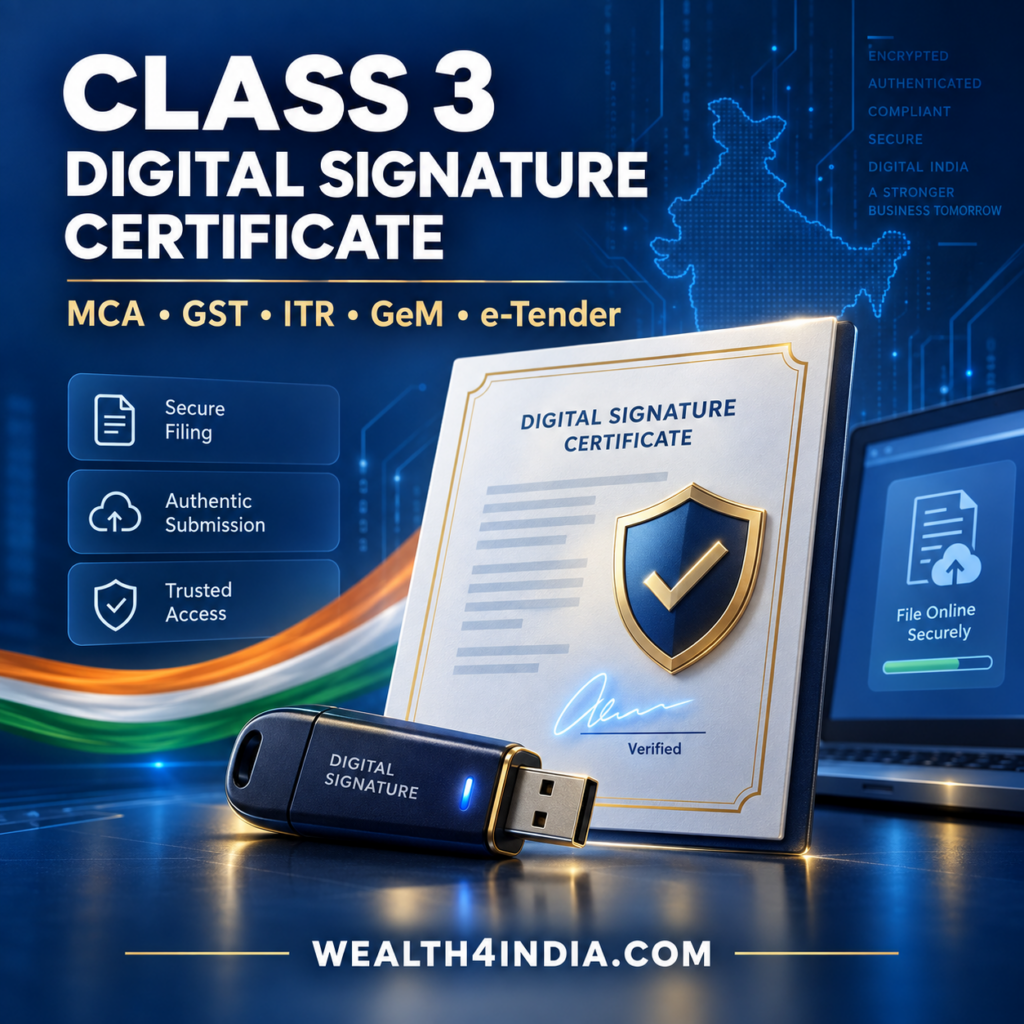
A Class 3 Digital Signature Certificate is a secure electronic credential used to verify the identity of a person signing an online form, return, bid or document. It is widely required for MCA and ROC filings, GST compliance, income-tax filings, government e-tenders, GeM, DGFT, EPFO and several other regulatory portals in India.
However, every DSC is not suitable for every purpose. An individual signing certificate may be sufficient for income-tax or MCA filings, while an e-tender may require both signing and encryption certificates. An importer, foreign director or NRI may also need a different verification and documentation route.
This guide explains how to select, apply for, use and safely renew a Class 3 DSC in India.
What is a Digital Signature Certificate?
A Digital Signature Certificate, commonly called a DSC, electronically connects a verified identity with a cryptographic key. When a document is signed using the private key stored in the DSC, the recipient can verify:
- who signed the document;
- whether the certificate was valid at the time of signing; and
- whether the document was changed after it was signed.
A DSC is therefore different from a scanned image of a handwritten signature. A pasted signature image does not provide cryptographic authentication or reveal whether the document was subsequently altered.
Under Sections 3 and 5 of the Information Technology Act, 2000, a digital signature applied in the prescribed manner receives legal recognition. Digital Signature Certificates are issued by Certifying Authorities licensed by the Controller of Certifying Authorities under the Ministry of Electronics and Information Technology.
The Controller of Certifying Authorities clarifies that the CCA licenses and regulates Certifying Authorities, while the licensed Certifying Authorities issue certificates to individual subscribers.
Why is a Class 3 Digital Signature Certificate needed?
Government and regulatory portals use a DSC to authenticate the person submitting a form or approving a transaction. It reduces paper-based filing while providing a verifiable record of the signatory’s identity.
A Class 3 DSC is commonly used for:
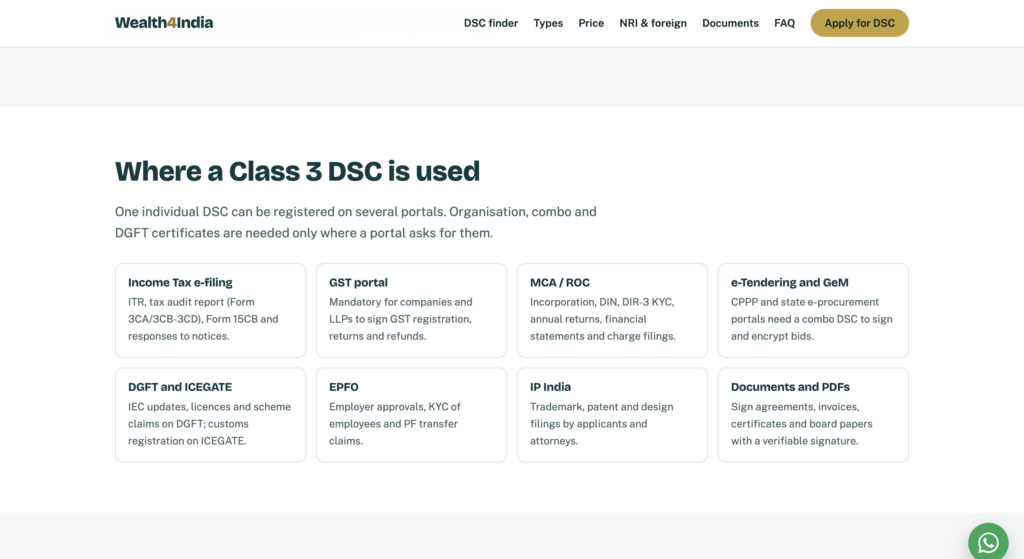
1. MCA and ROC filings
Directors, designated partners, company secretaries, chartered accountants and other authorised professionals use DSCs for:
- company and LLP incorporation;
- SPICe+ and FiLLiP forms;
- DIN and director-related filings;
- annual financial statements and annual returns;
- charge creation or modification;
- statutory certifications; and
- other ROC forms.
Promoters planning a new entity can obtain coordinated assistance for the DSC, DIN and incorporation process through company and LLP formation services. A detailed professional overview is also available under company and LLP registration advisory.
2. Income-tax filing and tax audit
A DSC may be used for income-tax returns, tax audit reports, statutory forms, Form 15CB and other electronic submissions. It is particularly relevant for companies, persons subject to tax audit and professionals uploading certified reports.
The Income Tax Department’s DSC registration user manual explains the process for registering or re-registering a certificate on the e-filing portal.
Individual taxpayers and businesses requiring return preparation can separately use CA-assisted income-tax return filing.
3. GST registration and returns
Companies, LLPs and specified taxpayers use DSCs to authenticate GST applications, returns, refund claims, LUTs and other submissions. The authorised signatory’s DSC must be correctly registered and mapped on the GST portal before filing.
Businesses can obtain coordinated assistance for DSC registration and GST registration and return filing.
4. Government e-tenders and e-procurement
Government tender portals commonly require a Class 3 DSC to sign bid documents. Some portals also require an encryption certificate to encrypt the technical or financial bid before submission.
Because tender requirements differ, applicants should check whether the relevant portal requires:
- signing DSC only;
- signing and encryption DSC;
- individual or organisation DSC; or
- DSC in the name of a specifically authorised representative.
Buying only a signing certificate where a combo certificate is required can prevent submission of the bid.
5. Government e-Marketplace
Sellers, service providers and authorised representatives may need a DSC for selected GeM functions, bid participation and document authentication. Businesses entering government procurement can consider integrated GeM registration and vendor support.
6. DGFT, IEC and ICEGATE
Importers and exporters use DSCs for selected DGFT applications, licence-related processes, scheme claims and customs-related registrations. The organisation details, authorised signatory and IEC records should be consistent to avoid validation errors.
7. EPFO, intellectual property and other filings
DSCs are also used for:
- EPFO employer approvals;
- trademark, patent and design filings;
- professional certifications;
- digitally signed invoices and certificates;
- bank and institutional documentation; and
- execution of verifiable PDF documents.
Businesses protecting a brand may combine their DSC requirement with trademark registration in India.
Which type of Class 3 DSC should you choose?
Selecting the correct certificate is more important than simply purchasing the cheapest option.
| Type of DSC | Generally suitable for |
| Individual signing DSC | Income tax, GST, MCA, EPFO, professional filings and PDF signing |
| Organisation signing DSC | Signing on behalf of a company, LLP, firm, trust or other organisation |
| Combo DSC—signing and encryption | E-tenders, e-procurement and portals requiring encrypted uploads |
| DGFT or IEC-linked DSC | Import-export and specified DGFT-related transactions |
| NRI DSC | Indian citizens residing outside India |
| Foreign national DSC | Foreign directors, subscribers, designated partners and foreign applicants |
| Foreign organisation DSC | Authorised signatories acting for an overseas organisation |
| Document signer certificate | Automated bulk signing of invoices, statements or certificates through software |
Before applying, identify the portal and exact transaction for which the certificate will be used. The interactive Class 3 Digital Signature Certificate service page provides a DSC finder, current price options and applicant-specific document lists.
Signing DSC versus combo DSC
A signing DSC authenticates a return, form or document and protects it against undetected alteration.
A combo DSC normally contains:
- a signing certificate; and
- an encryption certificate.
The encryption component is mainly relevant where a tender or procurement portal encrypts confidential bid documents. An applicant who only needs to file an income-tax return, GST form or MCA form may not require an encryption certificate.
Always check the tender or portal specification before placing the order.
Documents required for a Class 3 DSC
The documentation depends on whether the applicant is an Indian resident, organisation, NRI, foreign national or foreign company.
Indian individual
Generally required:
- PAN card;
- Aadhaar or another permitted identity and address proof;
- recent photograph;
- active mobile number;
- active email address; and
- video verification.
Aadhaar-based electronic KYC may simplify the verification process where the mobile number is active and linked.
Indian company, LLP, firm, trust or society
Generally required:
- PAN of the organisation;
- certificate of incorporation, LLP certificate, partnership deed or registration certificate;
- GST registration certificate, where applicable;
- authorisation letter or board resolution;
- PAN and identity proof of the authorised signatory;
- mobile number and email address of the signatory; and
- video verification.
The authorisation should clearly identify the person permitted to obtain and use the DSC on behalf of the organisation.
NRI applicant
An Indian citizen residing abroad may generally need:
- valid Indian passport;
- overseas address proof;
- visa, work permit or residence permit;
- PAN, where available;
- recent photograph;
- active email and mobile number;
- video verification; and
- apostilled or consular-attested documents where required.
Foreign national
A foreign national may generally need:
- valid foreign passport;
- overseas address proof;
- photograph;
- email and mobile number;
- video verification;
- apostille or Indian Embassy/High Commission attestation, as applicable; and
- certified English translation of documents issued in another language.
Foreign company or organisation
Additional documents may include:
- certificate of incorporation or registration;
- registered-office proof;
- board resolution or authorisation letter;
- passport and address proof of the authorised signatory; and
- appropriately apostilled or consular-attested copies.
The precise list can vary between Certifying Authorities and applicant categories. Documents should therefore be checked before incurring apostille, notarisation or courier expenses.
How to apply for a Class 3 DSC online
The process can usually be completed in the following steps:
Step 1: Identify the correct DSC
Confirm the purpose, portal, applicant category, validity period and whether encryption is required.
Step 2: Submit identity and address documents
Upload clear and current copies. The applicant’s name should be consistent across PAN, Aadhaar, passport, organisation records and portal registrations.
Step 3: Complete mobile and email verification
OTP verification is generally completed using the applicant’s own mobile number and email address.
Step 4: Complete video verification
The applicant records or attends a short video verification in accordance with the Certifying Authority’s instructions.
Step 5: Obtain approval and certificate issuance
After verification, the Certifying Authority approves and issues the certificate. Most user-based certificates are stored in an approved secure crypto token.
Step 6: Register the DSC on the relevant portal
Issuance alone does not automatically activate the DSC on every government portal. It may need to be separately registered or associated with the user account on MCA, GST, Income Tax, DGFT, EPFO or the relevant tender portal.
Class 3 DSC cost and validity
The cost of a DSC depends on:
- individual or organisation category;
- signing-only or signing-and-encryption combination;
- certificate validity;
- new token or token reuse;
- Indian, NRI or foreign-national verification;
- domestic or overseas courier charges; and
- the issuing Certifying Authority.
Applicants should compare the complete price, including GST, token and delivery, rather than only the certificate component. The current Class 3 DSC price and validity options may be checked before applying.
The validity period is printed in the certificate. On expiry, a fresh certificate must be issued after the prescribed verification; the validity of the old certificate is not merely extended.
DSC renewal and expiry planning
Do not wait for the filing deadline to discover that the DSC has expired.
Before an important ROC, GST, income-tax or tender deadline:
- check the certificate’s expiry date;
- confirm that the USB token is working;
- update the token driver;
- install the portal’s current signing utility;
- verify that the DSC is registered on the portal; and
- test it on the computer from which the filing will be made.
Where a compatible token is already available, it may be possible to load the newly issued certificate onto the existing token. Compatibility should be confirmed before renewal.
Common reasons why a DSC does not work
A valid certificate can still fail because of a technical or registration issue. Common reasons include:
- certificate not registered on the portal;
- PAN or name mismatch;
- expired or revoked certificate;
- incorrect DSC type;
- outdated token driver;
- signing utility not installed or not running;
- browser or operating-system compatibility problem;
- token PIN locked after repeated incorrect attempts;
- use of an organisation DSC where an individual DSC is required; or
- absence of an encryption certificate for an e-tender.
Applicants in Delhi NCR can obtain coordinated filing and compliance assistance through a Chartered Accountant in Dwarka or for incorporation-related work through company registration services in Dwarka.
Important DSC security precautions
A DSC can authorise legally significant filings. It should be controlled with the same care as a banking credential.
- Do not share the token PIN through WhatsApp or email.
- Do not leave the token permanently connected to a computer.
- Do not permit an unauthorised employee or intermediary to use it.
- Maintain an internal record of forms signed with the DSC.
- Change the token PIN from the default setting.
- Inform the issuing Certifying Authority immediately if the token is lost.
- Seek revocation if misuse or compromise is suspected.
- Keep the certificate holder’s email and mobile number accessible.
- Renew the certificate before critical filing or tender dates.
The Information Technology Act, related rules and official regulatory material are available on the CCA’s Acts and Guidelines page.
Frequently asked questions
Is a Class 3 Digital Signature Certificate legally valid in India?
Yes. A digital signature applied in accordance with the Information Technology Act, 2000 and the prescribed rules receives legal recognition. The certificate should be issued by a licensed Certifying Authority and remain valid and unrevoked when used.
Is a scanned signature the same as a DSC?
No. A scanned signature is only an image. A DSC uses cryptographic keys and a verified certificate to authenticate the signatory and detect subsequent changes to the signed electronic record.
Can one DSC be used on MCA, GST and Income Tax portals?
A suitable individual signing DSC may generally be registered on more than one portal. However, each portal requires separate registration or association, and a specialised organisation, DGFT or encryption certificate may be required for certain transactions.
Which DSC is required for e-tendering?
Many e-tender portals require a Class 3 combo DSC containing signing and encryption certificates. The bid document or portal instructions should be checked before applying.
Can an NRI obtain an Indian DSC without visiting India?
Yes. An NRI can generally complete document submission, OTP and video verification from abroad. Passport and overseas address documents may require apostille or consular attestation, depending on the applicable verification route.
Can a foreign director obtain a DSC?
Yes. Foreign directors, subscribers and designated partners can obtain a foreign-national DSC after completing passport-based identity verification and the prescribed attestation requirements.
Is a DSC automatically renewed on expiry?
No. Renewal involves issuance of a fresh certificate after completing the applicable verification. A compatible existing token may sometimes be reused.
What should be done if the DSC token is lost?
The issuing Certifying Authority should be contacted immediately to initiate revocation. A fresh certificate and, where necessary, a new token should then be obtained.
Conclusion
A Class 3 Digital Signature Certificate is an essential compliance credential for companies, LLPs, professionals, importers, exporters, government vendors, NRIs and foreign directors dealing with Indian regulatory portals.
The key is to choose the certificate according to the applicant, portal and transaction—not merely by price. Confirm whether you need an individual, organisation, DGFT or combo DSC; complete the correct verification; register it on the relevant portal; and maintain strict control over the token and PIN.
For assistance with selection, document verification, issuance, renewal or overseas delivery, visit the Digital Signature Certificate online application page.
Disclaimer: This article is intended for general informational purposes. Portal requirements, Certifying Authority procedures, documentation and prices may change. Applicants should verify the current requirements for their particular portal and transaction before applying.
This article is for general information only and does not constitute legal, tax, investment or financial advice. Positions may change with amendments, notifications or judicial rulings. Please consult our team before acting on anything set out here.

wealth4india
Wealth4India Pvt Ltd — an integrated tax, wealth and business advisory practice based in Dwarka, New Delhi, serving clients across India and 35+ countries.
Leave a Reply