Class 3 DSC : Essential Guide to Documents, Costs & NRI Use
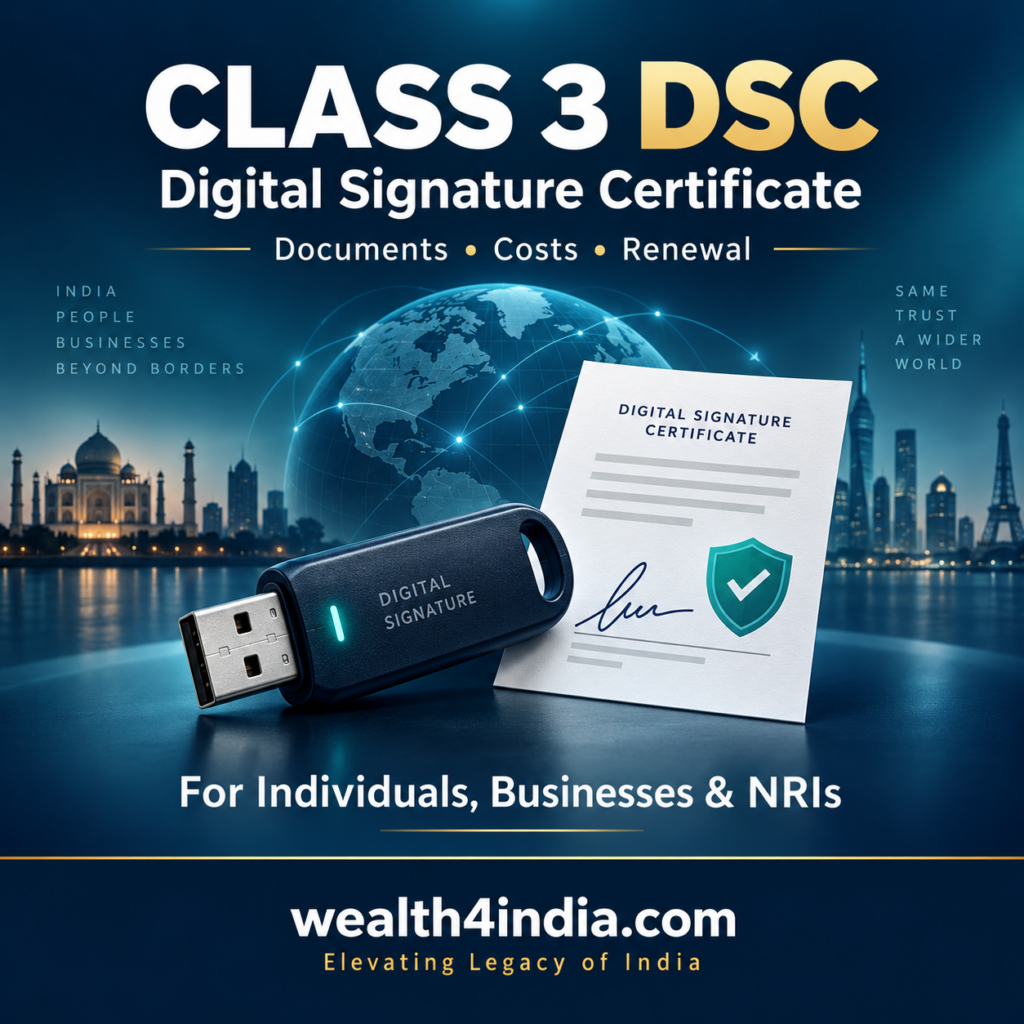
A Class 3 DSC helps individuals and authorised business signatories authenticate electronic documents and complete filings on compatible Indian portals. Whether you need a digital signature certificate in Dwarka, a certificate for corporate compliance or a DSC for NRI filings from overseas, selecting the correct certificate is the first step.
A successful application involves more than buying a USB token. The applicant’s identity, signing capacity, certificate details, verification route and intended portal must work together.
This guide explains the practical choices, documents, costs and renewal considerations. You can also explore Wealth4India’s digital signature certificate services for application assistance and current package details.
What is a Class 3 DSC?
A Digital Signature Certificate connects a verified identity with a public cryptographic key. When a document is digitally signed using the corresponding private key, a compatible system can verify the signature and detect subsequent changes to the signed content.
A Class 3 DSC provides a higher level of identity assurance within India’s public key infrastructure. It is commonly used for business and government filing applications.
Digital authentication and recognition operate within the framework of the Information Technology Act, 2000, including Section 3 on authentication through digital signatures and Section 5 on legal recognition of electronic signatures, subject to the applicable statutory conditions.
DSCs are issued by Certifying Authorities licensed by the Controller of Certifying Authorities, or CCA. An application service provider may assist with documentation and setup, while the licensed Certifying Authority performs the required verification and issuance. The distinction is explained in the CCA’s official DSC guidance.
A scanned handwritten signature is different: it does not, by itself, provide the certificate-based verification of a digitally signed document.
Which Class 3 DSC should you choose?
Start with the intended use. Tell the service provider who will sign, in what capacity, and on which portal.
| Requirement | What to check before applying |
| Individual tax or document signing | Applicant identity, PAN requirements and portal compatibility |
| Director or designated-partner filings | The individual signer’s details and required MCA association |
| Signing with organisational affiliation | Organisation details and authority of the named signatory |
| Government tenders and procurement | Required certificate class, organisational attributes and any encryption requirement |
| NRI or foreign-national application | Applicable identity and address-verification route |
| Import-export work | Certificate details required by the relevant DGFT or customs workflow |
| Automated bulk document signing | Whether a document-signer certificate is appropriate for the software and intended use |
Current Certifying Authority offerings distinguish individual and organisation certificates, signing and encryption options, and different validity periods. Class 3 DSC is therefore a starting specification; the remaining attributes still matter.
Signing DSC versus signing-and-encryption DSC
A signing certificate supports authentication and integrity checks. An encryption certificate serves a separate confidentiality function.
A “combo” package commonly includes both. However, the extra encryption component should be selected because the intended application requires it.
Before ordering for a tender, send the provider the portal name and relevant certificate instructions. This is more useful than requesting a generic “tender DSC.”
Individual signing versus automated document signing
A director’s certificate and an organisation’s automated document-signer certificate serve different purposes.
CCA specifically explains that a document-signer certificate does not replace the signature of the organisation’s authorised signatory. Businesses planning automated invoice, statement or certificate signing should assess that requirement separately.
Class 3 DSC for MCA, ROC and company compliance
Businesses commonly require digital signatures for corporate forms and related electronic filings.
If you are arranging a DSC for MCA filing, confirm:
- Who must sign the particular form.
- Whether the person’s identifying details match the records used for filing.
- Whether the certificate remains valid.
- Whether the DSC has been associated with the relevant MCA account.
MCA’s published guidance requires the person signing and filing forms to associate their DSC on the portal. Certificate issuance and portal association are separate steps.
For a new venture, coordinate the DSC requirement with your company incorporation process. Existing companies and LLPs can align certificate validity with their ROC filing and annual compliance requirements.
Practical example: Before a company begins its annual filing exercise, check the relevant directors’ certificates and portal associations. Discovering an expired certificate at the signing stage can delay an otherwise completed filing.
DSC for income tax filing and GST
Income-tax returns and other electronic submissions
A DSC for income tax filing must be registered on the e-Filing portal before it can be used there.
The Income Tax Department identifies particular services and taxpayer categories for which DSC verification is mandatory. In other cases, alternative verification methods may be available. NRI status alone should not be treated as a universal requirement to use DSC for every return.
Check the applicable filing and verification requirements through the Department’s Register DSC FAQs.
Where you need assistance with the return itself, combine certificate planning with income-tax return filing support.
GST registration, returns and applications
GST portal requirements depend on the entity and filing concerned. Official GST guidance identifies DSC requirements for companies and LLPs in relevant workflows.
Check the authorised signatory’s PAN, certificate registration and applicable signing method before submission.
Businesses can coordinate this with GST registration and return filing services, particularly when a signatory changes or an existing certificate expires.
DSC for government tenders and GeM
For contractors and suppliers, a valid certificate may be essential to completing an electronic procurement transaction.
The Delhi government eTendering portal specifies a Class 3 DSC for its e-filing process. Other procurement systems should be checked against their own current instructions.
Before applying for a DSC for government tender, confirm:
- The exact procurement portal.
- The individual authorised to submit the bid.
- Required organisation details.
- Whether signing alone or signing plus encryption is required.
- Certificate-mapping and technical setup requirements.
For a DSC for GeM portal requirement, identify the transaction and user role first. Do not assume that every GeM activity follows the same verification process as another tender platform.
Wealth4India’s GeM registration and vendor support services can help businesses review the wider onboarding and compliance steps.
Recommended practice: Complete certificate registration and test the signing setup before the bid deadline. A valid certificate cannot compensate for an untested computer or incomplete portal mapping.
DSC for NRI and foreign-national applicants
An overseas applicant may need an Indian DSC for company responsibilities, particular tax filings, business documentation or procurement activities.
However, citizenship, residence and signing capacity are different questions:
- An Indian citizen living abroad may be applying in a personal capacity or as a company signatory.
- A foreign citizen may require a certificate for an Indian directorship or another permitted filing.
- An authorised person acting for a foreign organisation may need organisation-related verification.
CCA’s current foreign-applicant eKYC provisions consider both the address and identity documents used in the application. The provider should confirm the applicable route before recommending a product.
Can you obtain an Indian DSC from abroad?
Remote application routes are available, subject to the issuing Certifying Authority’s requirements.
For applicants in the USA, UK, Australia, Russia, Singapore, Dubai and elsewhere in the UAE, Germany, France or other countries, practical planning should cover:
- A suitable verification appointment.
- Access to the applicant’s own email and telephone.
- Availability of original documents during verification.
- Delivery arrangements where a token is required.
- Computer and portal setup after receipt.
Confirm destination-specific delivery availability and timing before making a filing commitment.
Is apostille or embassy attestation always compulsory?
A blanket requirement should not be assumed.
CCA’s Identity Verification Guidelines include an eKYC route for foreign applicants involving document checks and video verification. The requirements depend on the selected route and the issuing authority’s process.
Ask for the applicable document checklist before spending on notarisation, apostille, embassy attestation or translation.
What should NRIs and HNIs consider?
For HNIs managing several Indian business interests, it is useful to maintain a signing register showing:
- The person who holds each certificate.
- The capacity in which that person signs.
- Certificate expiry dates.
- Portals on which registration has been completed.
- Responsibility for requesting renewal.
We recommend planning certificates around actual filings and responsibilities.
Where the underlying matter concerns Indian income, property-related taxation or overseas reporting, obtain separate NRI tax advisory assistance. A digital signature authenticates a submission; it does not determine whether the underlying tax treatment is correct.
Documents required for a digital signature certificate
Prepare an initial checklist, then obtain confirmation of the accepted documents for your application route.
| Applicant | Typical information or documents to prepare |
| Indian individual | PAN, accepted identity/address evidence and contact details |
| Organisation signatory | Personal identification, organisation records and authorisation |
| NRI or foreign individual | Passport or accepted identity evidence, address proof, photograph and contact details |
| Foreign organisation signatory | Applicant documents, organisation registration/address evidence and authorisation |
The precise requirements vary by verification route and certificate type. CCA publishes the governing Identity Verification Guidelines; issuing authorities also publish their application checklists.
Before submission, compare the spelling of the applicant’s name across the documents and the intended filing portal. Where details differ, ask how the mismatch should be resolved before issuance.
Keep the application under the applicant’s control. Use the applicant’s appropriate contact details and complete their required verification directly.
Class 3 DSC price: what should the quotation include?
When comparing Class 3 DSC price quotations, check the complete package:
| Cost component | Question to ask |
| Certificate | Which applicant category and certificate type are included? |
| Validity | What are the actual start and expiry dates? |
| USB token | Is compatible hardware included or charged separately? |
| Encryption | Is an additional encryption certificate included? |
| Taxes | Is GST included in the quoted total? |
| Delivery | Are domestic or international courier charges included? |
| Assistance | Does the fee include installation and portal-registration help? |
| Renewal | Can the existing token be reused, subject to compatibility? |
At the time of this review, Wealth4India’s service page lists starting prices for an individual Class 3 signing DSC of ₹1,999 for one year, ₹2,299 for two years and ₹2,999 for three years, with GST and a USB token included for those packages.
Check the current digital signature certificate prices and obtain a written quotation for your applicant category, delivery location and support requirements.
A certificate quote should also identify the licensed issuing authority. This makes it easier to understand issuance, renewal and revocation responsibilities.
How to apply for a Class 3 DSC online
Use the following sequence to reduce avoidable delays.
Step 1: Identify the intended use
List the portals and documents for which you need the certificate. State whether you are applying personally, as a director, as an organisation’s authorised signatory or from overseas.
Step 2: Confirm the certificate and verification route
Obtain confirmation of the certificate attributes, documents, fees and expected processing arrangements.
Ask about any additional verification before arranging attestations or purchasing hardware.
Step 3: Complete the application requirements
Submit the accepted information and complete the prescribed identity checks. Follow the issuing authority’s authentication and payment sequence.
Step 4: Check the issued certificate
Verify the holder’s name, validity and relevant identifying details. Raise any discrepancy immediately.
Step 5: Complete portal registration and a test
Install the appropriate token driver and the signing utility currently specified by the relevant portal.
For income-tax use, the official DSC registration user manual describes registration through the profile section and covers replacement or renewed certificates.
Application completion and filing readiness are separate milestones. Allow time for delivery, software setup and portal registration.
DSC renewal online: plan before the deadline
Treat DSC renewal online as a fresh certificate-issuance exercise rather than assuming the existing expiry date can simply be extended.
Before renewal, check:
- The expiry recorded in the actual certificate.
- Whether the existing token remains compatible.
- Any change in identity, contact or organisation details.
- Whether signing or encryption requirements have changed.
- Portals on which the replacement certificate must be registered.
The Income Tax Department’s registration service expressly supports registering a new certificate when the earlier one has expired or remains valid.
As an internal practice, we recommend reviewing expiry dates at least a month before important filing periods. Overseas applicants should also allow time for delivery if replacement hardware is needed.
Do not assume renewal updates every portal automatically. Include portal registration in your completion checklist.
Digital signature certificate in Dwarka, Delhi and across India
If you need a digital signature certificate in Dwarka, local coordination can help with document queries, token collection and setup arrangements.
Wealth4India’s DSC desk is based in Sector 4, Dwarka, New Delhi. Applicants in the surrounding approximately 25 km service area—including nearby parts of Janakpuri, Uttam Nagar, Palam, Najafgarh, Mahipalpur and Vasant Kunj—can enquire about available local arrangements.
Applicants seeking DSC in Mumbai, Patna, Bengaluru/Bangalore, Pune or Noida, and elsewhere in India, can enquire about remote verification and courier delivery. Confirm the delivery postcode and expected schedule when applying.
The place of application should not distract from the essential checks: correct applicant details, suitable certificate attributes and readiness for the intended portal.
Five mistakes to avoid when applying for a DSC
1. Choosing only by the lowest advertised price
Compare the certificate, token, taxes, delivery and support together. A low certificate-only price may not represent the complete cost.
2. Ordering without identifying the portal
Tell the provider the actual use. “For business” is often insufficient to decide the required attributes.
3. Assuming every overseas applicant follows the same process
A foreign address, foreign passport and organisation affiliation can affect the verification route. Confirm the checklist for your circumstances.
4. Leaving installation until the filing deadline
Check the computer, token driver, signing utility and portal registration in advance.
5. Sharing control of the signing key
Keep the token and PIN under the certificate holder’s control. If the token is lost or compromise is suspected, promptly contact the issuing authority about revocation.
CCA’s guidance emphasises subscriber custody and states that signing keys should not be copied.
Frequently asked questions
Can I use one Class 3 DSC on several portals?
Often, yes, provided its details and permitted use satisfy each portal. Registration or association may need to be completed separately. Confirm suitability before ordering additional certificates.
Is DSC mandatory for every NRI income-tax return?
No. The requirement follows the applicable taxpayer category, form and verification rules. Being an NRI does not, by itself, make DSC compulsory for every return.
Can a foreign director apply without travelling to India?
Remote verification routes are available. Confirm the issuing authority’s requirements and allow time for any token delivery and MCA association.
Can I renew a DSC using an existing USB token?
Reuse may be possible if the token is compatible and meets the applicable requirements. Obtain confirmation before selecting a package without new hardware.
Is signing-and-encryption DSC necessary for every GeM activity?
Check the particular transaction and current portal instructions. Do not infer a universal requirement from the certificate used on a different procurement platform.
Does a DSC work like a scanned signature?
No. Certificate-based digital signing enables cryptographic verification. A pasted signature image does not provide that functionality by itself.
Can an Indian DSC be used for every overseas document?
Do not assume universal acceptance. Confirm the receiving organisation’s requirements and the applicable legal framework before relying on an Indian DSC outside its intended use.
How long does a DSC application take?
Timing depends on successful verification, document queries, the issuing authority and delivery arrangements. Ask separately about certificate issuance and when you will be ready to sign on the required portal.
Apply for the DSC that fits your requirement
Before applying, share four details: your applicant category, country of residence, intended portal and filing deadline.
Wealth4India assists with certificate selection, application coordination and relevant setup support through licensed issuing Certifying Authorities.
Whether you are an individual in Dwarka, a business in Mumbai or Patna, a director in Bengaluru, Pune or Noida, or an overseas applicant managing Indian compliance, start with the DSC application and renewal enquiry.
Contact: +91 92662 42424
Email: info@wealth4india.com
Wealth4India — Elevating Legacy of India
Class 3 DSC : Essential Guide to Documents, Costs & NRI in India ( Easy Guide )
This article is for general information only and does not constitute legal, tax, investment or financial advice. Positions may change with amendments, notifications or judicial rulings. Please consult our team before acting on anything set out here.

wealth4india
Wealth4India Pvt Ltd — an integrated tax, wealth and business advisory practice based in Dwarka, New Delhi, serving clients across India and 35+ countries.
Leave a Reply